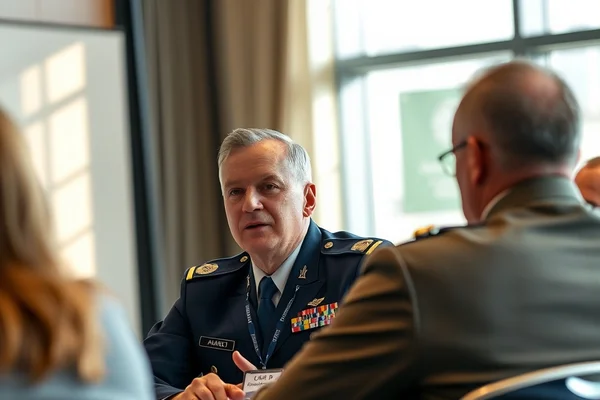
The third annual Modular Open Systems Approach (MOSA) for Defense Summit in National Harbor gathered senior military officials, industry partners, and standards experts to discuss how open‑architecture frameworks are shaping the future of U.S. defense platforms across air, land, sea, and space.
From April 8‑9, 2026, National Harbor, Maryland hosted the third MOSA for Defense Summit, a convening that brought together Tri‑Service leaders, defense contractors, and standards organizations. The event, moderated by former Navy Assistant Secretary of Research, Development, Test and Engineering Hon. Nickolas Guertin, focused on translating open‑architecture principles into tangible improvements in lethality, resilience, and acquisition speed.
Air superiority and MOSA: Colonel David Liu, Senior Material Leader at the Air Force Life Cycle Management Center, outlined how the Air Force is leveraging MOSA to accelerate the fielding of adaptable avionics and weapons systems. He stressed the importance of cross‑service collaboration to maintain a rapid, flexible development cadence while preserving rigorous testing standards.
Balancing IP and openness: Panel discussions examined the tension between protecting intellectual property and fostering interoperable, reusable components. Participants highlighted emerging licensing models and contractual frameworks that aim to reconcile these competing priorities.
Next‑generation vehicle integration: Sessions explored how MOSA can underpin the design of future ground, maritime, and space platforms, emphasizing modularity as a pathway to reduce lifecycle costs and simplify upgrades.
A notable portion of the summit was devoted to the Air Combat Electronics Program Office (PMA‑209) and its Avionics Architecture Team. Their showcase included:
Hybrid backplane chassis: A modular avionics chassis that combines 3U OpenVPX and VNX+ standards, providing a scalable upgrade route for legacy aircraft while supporting multi‑level security and mission‑specific configurations.
Standards‑focused briefings: Technical sessions on Sensor Open Systems Architecture (SOSA®), Future Airborne Capability Environment (FACE®), Hardware Open Systems Technologies (HOST), Open Mission Systems (OMS), and the C5ISR/EW Modular Open Suite of Standards (CMOSS). These briefings offered guidance on both business and engineering strategies for adopting open systems.
In a fireside conversation, Capt. Jarrod Hair, PMA‑209 Program Manager, reflected on the evolution of open standards within the Navy’s acquisition community. He credited Guertin’s long‑standing advocacy for establishing a foundation that now enables “nearly 145 defense professionals” to exchange practical lessons on MOSA implementation.
The summit underscored a shift in defense acquisition philosophy: from isolated, bespoke solutions toward interoperable, reusable building blocks. By aligning on common reference architectures—such as those championed by The Open Group FACE Consortium—services can reduce duplication, accelerate technology insertion, and maintain a sustainable supply chain for both new and legacy platforms.
While participants acknowledged that MOSA has progressed from “crawling to walking to jogging,” they also noted that a sprint remains ahead. Continued investment in standards development, joint testing facilities, and collaborative procurement models will be essential to fully realize the promise of open, modular defense systems.
For further information, contact the Public Affairs Office at 240‑808‑3152.