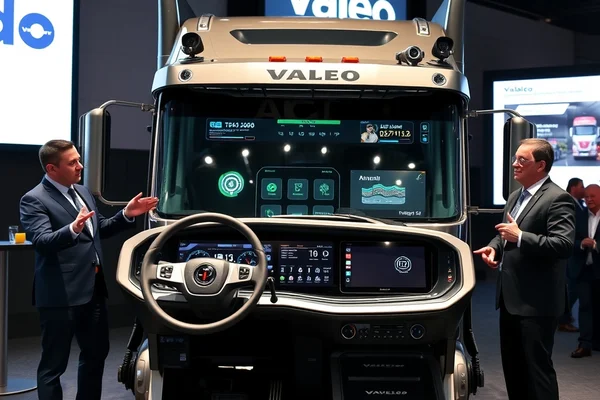
At the ACT Expo in Las Vegas, Valeo presented a suite of hardware and software solutions aimed at accelerating electrification, advanced driver‑assistance and software‑defined vehicle capabilities for commercial trucks—a sector poised for rapid growth as regulations tighten and autonomous technologies mature.
The ACT Expo, North America’s flagship event for clean‑transport and advanced vehicle systems, will host Valeo for the first time (May 4‑7, 2026, Las Vegas Convention Center, Booth 3242). The French supplier plans to showcase an integrated portfolio that spans electric power‑train components, sensor suites, high‑performance computing units and cabin‑comfort modules.
While Valeo’s presence is noteworthy, it reflects a broader shift in the trucking industry. Global commercial‑vehicle production reached 18 million units in 2025, with light commercial vehicles accounting for three‑quarters of output and medium‑ to heavy‑duty trucks the remaining quarter. Analysts project that electric trucks could claim a sizable share of new sales by 2030, driven by stricter emissions standards in Europe, China and the United States. Simultaneously, Level 4 autonomous driving is expected to move from pilot projects to limited commercial deployments within the next decade, especially on long‑haul corridors.
| Category | Key offerings | Potential impact |
|---|---|---|
| Electrification | EDC‑120 electric compressor with integrated inverter; smart heat pumps; on‑board chargers; e‑propulsion modules | Improves energy efficiency and reduces the thermal load on battery systems, a critical factor for range‑limited trucks. |
| Autonomous & SDV tech | Advanced sensor sets with cleaning systems; scalable compute platforms (Truck Smart Safety 360, ADAS domain controllers, modular multi‑domain units); “Valeo anSWer” intelligence hub for crowd‑sourced mapping and tele‑operation | Provides the hardware backbone for Level 2‑4 ADAS functions and supports future over‑the‑air updates, aligning with the software‑defined vehicle (SDV) paradigm. |
| Safety & Productivity | VisioBlade™ wipers for curved windshields; high‑performance lighting modules; Hands‑On‑Detection (HOD) for safe mode transitions; Ultra‑Wide‑Band (UWB) proximity detection for secure keyless entry | Enhances driver visibility and reduces the risk of cyber‑physical attacks, addressing both regulatory safety mandates and operator concerns. |
| Cabin Comfort & Monitoring | Advanced HVAC, interior lighting, 42‑inch ultra‑wide display, Driver Monitoring System (DMS) compliant with GSR II and NCAP 2026 | Aims to improve driver ergonomics and fatigue management, which are increasingly linked to fleet productivity and insurance costs. |
Valeo’s integrated approach mirrors a trend among Tier‑1 suppliers to bundle hardware and software into turnkey solutions. Competitors such as Bosch, Continental and ZF are also expanding their SDV and electrification portfolios, often through acquisitions of niche start‑ups or joint ventures with tech firms.
Regulatory pressure is a key driver. The U.S. Federal Motor Vehicle Safety Standards (FMVSS) are expected to tighten requirements for electronic stability and automated braking on heavy‑duty trucks by 2027. In Europe, the Euro VI emission standards already push manufacturers toward zero‑emission powertrains. These policies create a market incentive for fleets to adopt solutions that can be retrofitted or integrated at the vehicle design stage, a niche where Valeo’s “hardware‑plus‑software” model could find traction.
However, challenges remain. Battery cost and weight penalties still limit electric truck adoption on long routes, while autonomous technology faces hurdles in sensor reliability under adverse weather and in the legal framework for liability. Moreover, the fragmented nature of the commercial‑vehicle supply chain can slow the rollout of integrated systems, requiring close coordination between OEMs, fleet operators and aftermarket service networks.
For fleet managers, the promise of reduced total cost of ownership (TCO) hinges on three factors:
Valeo’s showcase at ACT Expo therefore serves as a barometer for how quickly these benefits might become commercially viable. The real test will be the speed of adoption by OEMs and the willingness of operators to invest in retrofitting existing fleets versus waiting for next‑generation trucks.
Valeo’s debut at the ACT Expo underscores the accelerating convergence of electrification, autonomy and software in the trucking sector. While the company’s portfolio is extensive, its success will depend on navigating regulatory timelines, proving reliability in harsh operating environments, and delivering clear ROI to fleet owners. As the industry moves toward a more sustainable and automated future, the next few years will reveal whether integrated solutions like those presented by Valeo can become the new standard or remain one of several competing approaches.